

2026 Midterm Update: Where Things Stand Two Weeks From Election Day
Oct 21, 2026
10 mins
Share
Overall Political Environment
This update highlights recent developments and what to watch in the final weeks before Election Day. For a more comprehensive analysis of key races and political dynamics, see our 2026 Election Overview, published Oct. 5.
With less than two weeks remaining before the Nov. 3 general election, the national political environment continues to favor Democrats, with the party well-positioned to regain control of the House and facing an increasingly plausible path to a Senate majority. Voters remain focused on affordability, the economy, healthcare and immigration, while President Trump’s approval rating has fallen into the high 30s across most national polling averages. Democrats have also maintained a lead on the generic congressional ballot.
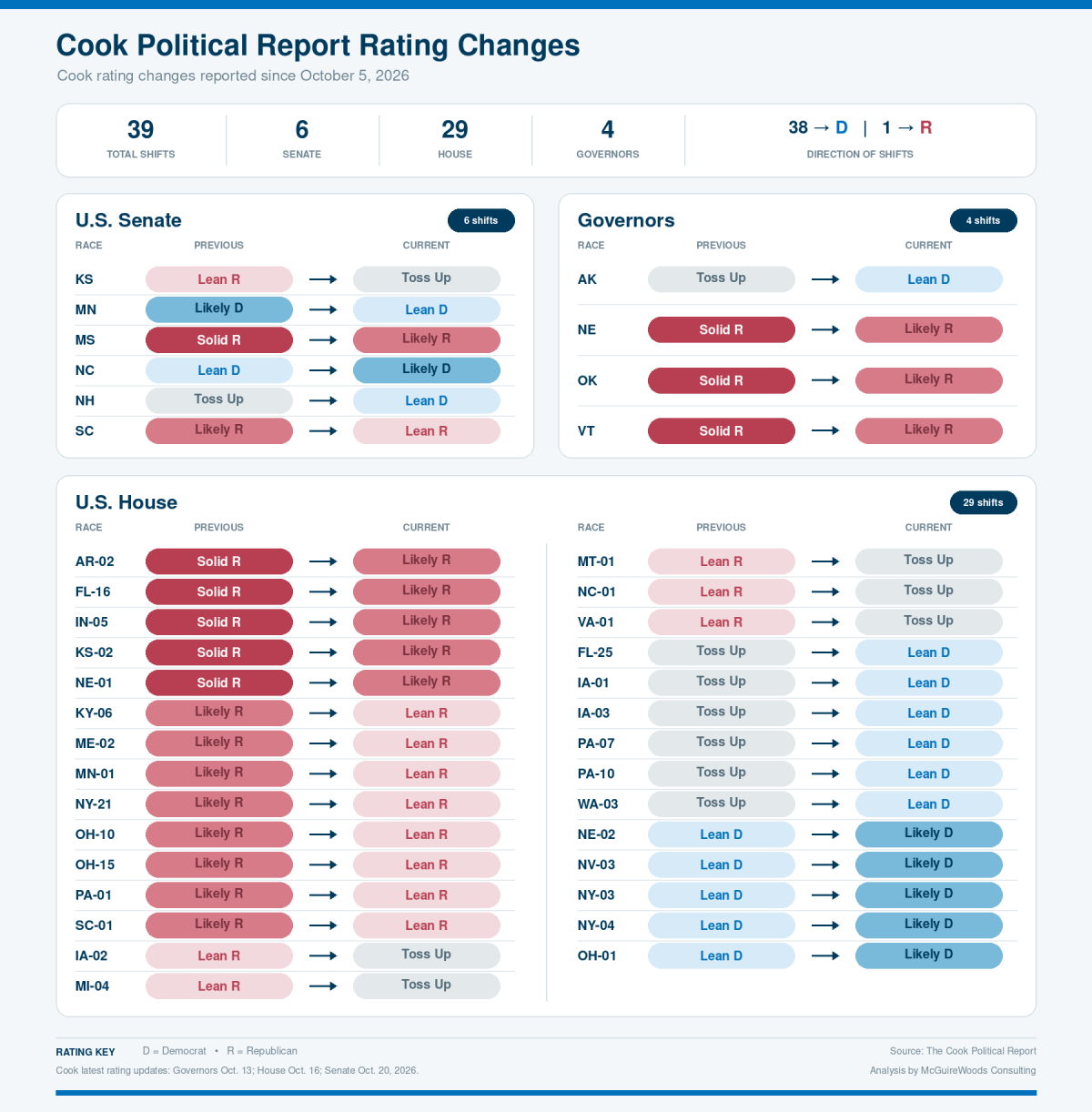
The latest race ratings largely reflect that Democratic momentum. Since our last update on Oct. 5, the Cook Political Report has changed its ratings for 39 Senate, House and gubernatorial contests, with 38 shifts favoring Democrats and one favoring Republicans. The shifts extend beyond traditional battlegrounds into states and districts that have generally favored Republicans in recent federal elections. As a result, Democrats are competing on a broader playing field, and Republicans are defending a wider set of seats entering the final weeks.
Nevertheless, Republicans retain important advantages. They begin with control of the White House and both chambers of Congress, their national committees and allied super PACs hold a substantial financial edge, and the Senate map still requires Democrats to win several races in states President Trump carried comfortably in 2024. The final two weeks will test whether those structural advantages can offset a less favorable national environment and an expanded competitive map.
House of Representatives
Democrats need 218 seats to win the House majority. Cook currently rates 214 seats as at least lean Democrat and 200 as at least ‘ean Republican, leaving 21 toss ups. Assuming all other races follow their ratings, Democrats would need to win four of those toss ups to secure control, compared with 18 for Republicans.
There are now 46 competitive House districts, defined as seats rated toss up or lean. The broader movement has continued to favor Democrats: all 29 House rating changes since Oct. 5 have shifted in their direction, and Republicans hold 16 of the 21 remaining toss ups, compared with five held by Democrats. This gives Democrats more potential pickup opportunities than seats they must defend.
Among the most notable changes are four Republican-held districts in Iowa and Pennsylvania that moved from toss up to lean Democrat: IA-01, IA-03, PA-07 and PA-10. Three of those incumbents won by fewer than two points in 2024, and the latest ratings indicate improving Democratic prospects in these closely contested seats.
The movement also extends beyond traditional battlegrounds. Montana’s 1st District moved from lean Republican to toss up despite President Trump carrying it by approximately 12 points in 2024. Other Republican-held districts in Ohio, Kansas and Nebraska have also become more competitive, suggesting that the national political environment is affecting races previously considered relatively secure for Republicans. Democrats’ principal defensive concerns are now the five Democratic-held toss ups in Florida, North Carolina, Texas and Ohio.
Both parties continue to adjust their spending strategies as the House map evolves. The Congressional Leadership Fund, a Republican-aligned super PAC focused on House races, has canceled planned spending in several contests, including Republican defenses in IA-01 and NJ-07 and potential pickups in MI-08 and OH-01. The group is redirecting resources to 16 other districts, including some Republican-held seats that were not previously considered especially vulnerable. These decisions reflect the challenge of allocating resources across a widening competitive map, even as Republicans retain a substantial outside spending advantage. Meanwhile, the Democratic Congressional Campaign Committee, House Democrats’ official campaign arm, has launched an additional fundraising push of $17 million to expand into districts in Ohio, Florida, Missouri and Arkansas that were not expected to receive significant national investment earlier in the cycle.
While a Democratic House majority is not guaranteed, Cook’s Oct. 9 projection called for a gain of approximately nine to 19 seats for the party, enough to secure control of the chamber even at the lower end of that range. The size of any resulting majority would have important implications for Democratic leadership’s ability to manage internal divisions, advance its legislative agenda and exercise its investigative and oversight authority.
Senate
The Senate remains the more difficult chamber for Democrats. Republicans currently hold a 53-47 majority. Democrats need a net gain of four seats to take control, while Republicans can sustain a net loss of three and retain the chamber through the vice president’s tie-breaking vote.
Ten Senate races are now competitive. Seven are toss ups: six Republican-held seats in Alaska, Iowa, Kansas, Maine, Ohio and Texas, and the Democratic-held seat in Michigan. Two additional Democratic-held seats, New Hampshire and Minnesota, are rated lean Democrat, while Republican-held South Carolina is rated lean Republican. North Carolina, an open Republican-held seat, was moved from lean Democrat to likely Democrat and is no longer included in the competitive count.
Assuming North Carolina follows its rating and Democrats retain their other seats, the party would need to win three of the six Republican-held toss ups to take control. Any Democratic-held seat lost to Republicans would require an additional pickup elsewhere. Michigan remains Republicans’ strongest pickup opportunity, followed by New Hampshire and Minnesota. Georgia, once viewed as a major Republican target, is now rated likely Democrat as Sen. Jon Ossoff has continued to widen his polling lead over Republican Rep. Mike Collins.
Kansas is among the most consequential Senate rating changes, moving from lean Republican to toss up as Republican Sen. Roger Marshall seeks reelection in a state that has not elected a Democratic senator since 1932. South Carolina also moved from likely to lean Republican, while Mississippi shifted from solid to likely Republican. Although Republicans remain favored in both races, the changes indicate growing competition in traditionally Republican territory. Minnesota was the only race to shift toward Republicans, moving from likely to lean Democrat as Democratic Lt. Gov. Peggy Flanagan faces a tighter-than-expected contest against Republican Michele Tafoya.
The parties’ late spending decisions provide one of the clearest indications of how the Senate map has shifted. Texas and Ohio have emerged as two of the most expensive Senate races of the cycle, attracting substantial investment despite President Trump carrying both states by double digits in 2024. The Senate Leadership Fund, the principal Republican-aligned super PAC focused on Senate races, has pulled back from Georgia and North Carolina while adding spending in Kansas, Nebraska and South Carolina, three states that were not expected to require significant national investment earlier in the cycle. Senate Majority PAC, its Democratic counterpart, has also scaled back advertising in Georgia and North Carolina, redirecting resources toward more closely contested races, including Michigan and Maine.
Republicans retain important advantages in the battle for Senate control, but Democrats’ expanding opportunities have made the map more competitive than anticipated and increased the number of races that could determine the chamber’s balance of power.
Governors
Thirty-six governorships are on the ballot, divided evenly between 18 Democratic-held and 18 Republican-held seats. Republicans currently hold 26 governorships nationally and Democrats hold 24, meaning Democrats need a net gain of two to take the lead nationally.
Cook rates Georgia, Nevada, Ohio and Wisconsin as toss ups. Georgia and Ohio are open Republican-held seats, while Republican Gov. Joe Lombardo faces a competitive reelection bid in Nevada. Wisconsin is the only Democratic-held toss up, presenting Republicans with a potential pickup opportunity following Gov. Tony Evers’ retirement.
The latest rating changes have all favored Democrats. Alaska moved from toss up to lean Democrat after moving from lean Republican earlier in the fall, making it one of Democrats’ leading pickup opportunities. Nebraska, Oklahoma and Vermont also moved from solid to likely Republican. Although Republicans remain favored in those three races, the changes underscore the difficult environment the party is facing up and down the ballot, including in states where they typically perform well.
Iowa presents another significant Democratic pickup opportunity. Cook rates the open Republican-held race between Democrat Rob Sand and Republican Zach Lahn as lean Democrat, adding to the party’s opportunities across the state’s congressional and statewide contests.
Republicans’ best opportunity to offset potential losses remains Kansas, where Democratic Gov. Laura Kelly is term-limited and the open race is rated lean Republican. Wisconsin offers another potential gain, although the race remains more competitive. New Hampshire is a defensive bright spot for the party, with Republican Gov. Kelly Ayotte maintaining a sizable polling lead over Democrat Cinde Warmington.
With two weeks remaining, both parties have credible opportunities to improve their position. Democrats have expanded the map into several Republican-held states, while Republicans retain pickup opportunities and several well-positioned incumbents. The final balance will depend on a small group of open seats and closely divided contests.
Attorneys General
There have been no changes to the attorney general ratings since our Oct. 5 update. Thirty attorney general offices are on the ballot, including 16 currently held by Democrats and 14 by Republicans. Nationally, Republicans hold 27 attorney general offices and Democrats hold 23.
Eight attorney general races remain competitive under Sabato’s Crystal Ball ratings. Michigan and Minnesota are rated toss ups. Arizona, Nevada and Wisconsin lean Democrat, while Georgia, Iowa and Kansas lean Republican. Democrats are defending four competitive attorney general offices in states President Trump carried in 2024 — Arizona, Michigan, Nevada and Wisconsin — creating a different political alignment from the gubernatorial and congressional maps.
These elections carry significance beyond their individual states. Attorneys general have increasingly been coordinating across state lines on litigation involving federal policy, consumer protection, antitrust, data privacy, healthcare and environmental regulation. Changes in the partisan balance could therefore affect both the composition of multistate coalitions and the enforcement priorities confronting companies over the next several years.
Campaign Spending
Republicans enter the closing stretch with a substantial financial advantage across the major national party committees and their aligned super PACs. The Republican-backed Senate Leadership Fund raised a record $272.9 million in the third quarter and ended September with more than $155 million in cash, compared with $151 million raised and $111.8 million on hand reported by its Democratic counterpart, Senate Majority PAC. Elon Musk accounted for $158 million of the Republican total, with the funds directed toward supporting Ken Paxton in Texas. He has also given $20 million to the Congressional Leadership Fund, $10 million to the Republican Governors Association and $2 million to the Republican Attorneys General Association.
Democrats, meanwhile, have demonstrated considerable fundraising strength at the candidate level, particularly in competitive Senate races. In Texas, Democrat James Talarico raised a record $64 million in the third quarter, compared with $18 million for Republican Ken Paxton, and Democrat Sherrod Brown outraised Republican Sen. Jon Husted in Ohio by more than five to one. Democratic Senate candidates in Georgia, North Carolina and Kansas also posted large hauls, most of them driven by contributions of $100 or less. In the House, Democratic candidates outraised their Republican opponents in 38 of the 42 most competitive races during the third quarter, according to an analysis of FEC filings. Because campaigns generally receive lower advertising rates than super PACs, Democratic candidates can stretch their fundraising dollars further, helping offset the Republicans’ outside spending advantage in key battlegrounds.
More than $1.2 billion in outside money has already been spent across competitive congressional races. In more than 70% of those contests, outside groups account for over half of all advertising. Republicans’ substantial outside spending advantage gives them the resources to compete across an expanding map, while strong Democratic candidate fundraising helps offset that advantage in key battlegrounds. With more races competing for national attention and resources, how effectively both parties deploy their remaining funds will be a critical factor in the final weeks before Election Day.
Looking Ahead
Democrats enter the final two weeks with momentum across the map. Of the 39 Cook rating changes since Oct. 5, 38 have favored the party, strengthening its position in the House and expanding its possible paths in the Senate and several gubernatorial races. The House presents Democrats’ clearest opportunity to gain control. The Senate remains more difficult, but Republicans are defending seats in more states than expected. Republicans’ substantial financial advantage gives the party resources to respond across that broader map, making the effectiveness of late spending and turnout operations especially important.
For businesses and organizations engaged with the federal government, the stakes extend beyond control of the legislative agenda. A Democratic House would bring new committee chairs, hearing priorities and oversight targets. Democrats would gain subpoena authority and could investigate administration policies, federal contracting and regulatory decisions, including the role of private-sector entities involved in those matters. They could also block legislation that depends on Republican votes alone, making appropriations, government funding and other must-pass measures more dependent on bipartisan negotiations. Their influence would be greater through oversight and negotiation than through enactment of a stand-alone Democratic policy agenda.
The balance of power in the Senate would have separate implications, particularly for judicial and executive branch nominations, including agency heads and independent regulators. A Republican Senate could continue advancing the president’s nominees, while a Democratic Senate could slow or block confirmations and establish its own committee and oversight priorities. If Republicans retain both chambers, the administration would preserve unified control of the federal government, although narrow majorities would continue to make individual members and internal party divisions important.
The election will therefore shape not only which policies can advance, but also who sets committee agendas, how aggressively Congress conducts oversight and how much leverage each party holds in negotiations. Organizations planning for 2027 and beyond should be prepared for meaningful changes in congressional leadership, oversight and legislative strategy under any form of divided government.
For additional perspective on the importance of engaging with congressional leadership ahead of the midterm elections, McGuireWoods Consulting senior advisor and former Democratic Congressman G.K. Butterfield offers insights on building relationships with Democratic lawmakers and the value of proactive, bipartisan engagement. Read his insights here.


Categories:
Insights